Advice · Extension
Extending your house rather than moving: the real sums with rates at 4%
10 November 2026 · 5 min read · By the Aldeak team
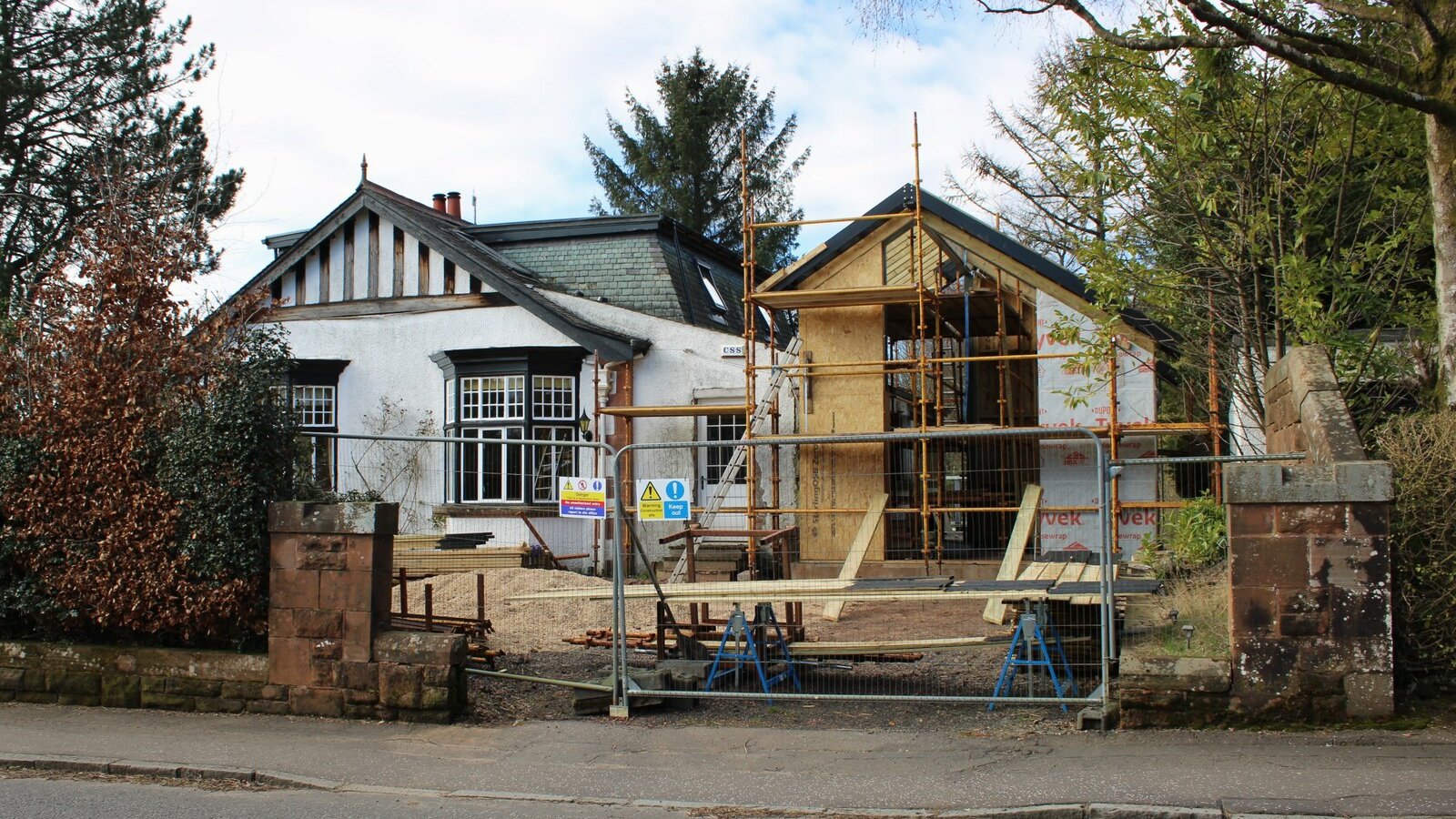
When the plot and the local urban plan (PLU) allow it, extending almost always costs less than moving: by changing house, more than €40,000 goes on notary fees, agency fees and removals, without a single extra square metre, and the whole difference in price is borrowed at close to 4%. For 25 to 30 m² more, an extension usually costs between €30,000 and €90,000, a loft conversion considerably less. Moving remains the right choice if the house cannot grow, if the neighbourhood no longer suits you, or if the work would exceed what the house will be worth afterwards.
Why the question arises this autumn
Mortgage rates are rising again. According to a mortgage broker, the average 25-year rate reached 3.85% in November 2026, and 4.07% for households earning less than €40,000 a year. Prices, on the other hand, are barely falling: −0.1% in October according to a national property price index. In Gironde, an older house sold for a median price of around €291,900 in 2025, and €473,700 in Bordeaux, according to the Gironde notaries.
Buying bigger is therefore expensive, and many families are looking at their house differently: a little-used garage, an empty loft, a garden large enough.
What moving costs, without gaining a square metre
When you change house, several expenses serve only to move from one roof to another:
- Notary fees on the purchase: around 7 to 8% of the price for an older property, mostly transfer duties. In Gironde, the department's share has been 5% since 2025 (4.5% for a first purchase of a main residence), according to the table of rates published by the DGFiP (the French tax authority).
- Agency fees on the sale, if you are paying them: they are not regulated and can be negotiated.
- The removal, and often a bridging loan if the purchase comes before the sale.
- The new loan: the difference between the sale price and the purchase price is borrowed at November 2026 rates, often higher than those of your current loan.
What an extension costs
The ranges below are orders of magnitude recorded in 2026 by building work comparison sites. Only quotes for your own house give the real price.
- Loft conversion: €800 to €1,500/m², provided there is enough headroom (at least 1.80 m to count towards the floor area) and a roof structure that allows it.
- Garage converted into a room: often the cheapest solution, because the walls, slab and roof already exist; what remains is insulation, a window and heating. The PLU sometimes requires a parking space to be kept.
- Single-storey extension: €1,200 to €2,500/m² in timber frame, €1,500 to €3,000/m² in masonry, finishes included.
- Raising the roof (adding a storey): €1,800 to €3,500/m², after a structural survey. Our article adding a storey or extending compares the two techniques.
When the lack of space is mainly about storage, simple fittings are sometimes enough: see our ideas for gaining space.
The sums for a family near Bordeaux
Take, as an example, a family with two children in a 90 m² house near Bordeaux, with no mortgage outstanding, who want 30 m² more.
Worked example: moving or extending by 30 m²
Amounts taken for the example; average broker rates for November 2026, excluding insurance.
| Moving: sale of the 90 m² house | €300,000 |
| Purchase of a 120 m² house | €390,000 |
| Agency fees (4%), notary (7.5%), removal | €12,000 + €29,250 + €2,500 |
| Amount to borrow, over 25 years at 3.85% | €133,750, i.e. €695/month |
| Extending: 30 m² extension at €2,200/m² | €66,000 |
| Plans, surveys, contingencies (10%) and development tax | €6,600 + €1,670 |
| Amount to borrow, over 25 years at 3.85% | €74,270, i.e. €386/month |
| Difference in favour of extending | around €309/month |
The development tax (taxe d'aménagement) is calculated with the 2026 value of €892/m², the 50% allowance on the 10 m² that remain within the first 100 m², and rates of 5% and 2.5% taken for the example: the details are in our article on the development tax on an extension. Here, 120 m² in total: a prior declaration is enough if the house is in an urban zone of a PLU, and an architect is not compulsory.
These sums do not tell the whole story: the new house may have a larger garden, a better school nearby, or hidden work. And an extension does not raise the value of the house square metre for square metre: a well-designed extension that connects well to the house adds value, a dark or badly placed room much less.
Permissions and timescales
- Read the PLU of the municipality (footprint, height, distance from boundaries) on the Géoportail de l'urbanisme (the national planning portal).
- Submit the right application: prior declaration for 5 to 20 m² created, up to 40 m² in an urban zone of a PLU; building permit beyond that, or if the total floor area then exceeds 150 m² (architect compulsory in that case).
- Wait for the decision: 1 month for a prior declaration, 2 months for a permit for a detached house, from the date the application is complete; longer in a protected area.
- Display the permission on the plot: neighbours have 2 months to challenge it.
- Build, then declare the new square metres to the tax office within 90 days of the end of the work.
Allow, in general, 6 to 12 months between the first plans and the completion of an extension, roughly the time it takes to sell and then buy.
Before signing a preliminary sale agreement or a quote, have what the PLU allows on your plot checked. A house that cannot grow changes the whole calculation: in that case, moving may become the best option again.
Mistakes to avoid
- Comparing the price per m² of an extension with that of property listings: you are not buying land again, nor paying notary fees.
- Forgetting the development tax and the increase in property tax.
- Extending beyond what the street is worth: a house far more expensive than its neighbours is hard to resell.
- Signing a quote without a structural survey for a raised roof or a loft conversion.
To get a price for your extension in Gironde, the Landes, the Basque Country or Charente-Maritime, see our full home renovation offer.
Sources : Pretto, « Taux immobilier novembre 2026 », mis à jour le 8 novembre 2026 : 3,76 % sur 20 ans et 3,85 % sur 25 ans en moyenne ; 4,07 % sur 25 ans pour les revenus inférieurs à 40 000 € par an · My Sweet Immo, 2 novembre 2026 : baromètre SeLoger–MeilleursAgents, prix en baisse de 0,1 % en octobre 2026, première baisse mensuelle de l'année · DGFiP, tableau des taux des droits de mutation par département au 1er mai 2026 : Gironde 5 % (4,5 % pour les primo-accédants, loi de finances pour 2025) · Notaires de France, « Les frais d'acquisition » : droits de mutation, émoluments et débours ; environ 7 à 8 % du prix dans l'ancien · La Tribune, 31 mars 2026, d'après la Chambre des notaires de la Gironde : prix médian des maisons anciennes en 2025, 291 900 € en Gironde et 473 700 € à Bordeaux · Service-public.fr, « Déclaration préalable de travaux », vérifié le 22 octobre 2026 : instruction en 1 mois · Service-public.fr, « Permis de construire », vérifié le 13 février 2026 : instruction en 2 mois pour une maison individuelle, architecte au-delà de 150 m² de surface de plancher · Service-public.fr, transformation d'un garage en pièce d'habitation, vérifié le 21 novembre 2025 : déclaration préalable · Service-public.fr, « Taxe d'aménagement », vérifié le 1er janvier 2026 : 892 €/m² en 2026 hors Île-de-France, abattement de 50 % sur les 100 premiers m² d'une résidence principale · Service-public.fr, recours contre une autorisation d'urbanisme, vérifié le 1er avril 2026 : 2 mois à partir du 1er jour d'affichage sur le terrain · Code de l’urbanisme, articles R. 421-14 et R. 421-17 (seuils de la déclaration préalable et du permis de construire) · ECOinfos, 2 novembre 2026 : extension 1 200 à 2 500 €/m² en ossature bois, 1 500 à 3 000 €/m² en maçonnerie (finitions comprises) ; surélévation 1 800 à 3 500 €/m² (ordres de grandeur) · Cedreo, « Prix d'un agrandissement de maison », mis à jour le 3 mars 2026 : aménagement de combles 800 à 1 500 €/m² (ordre de grandeur) · geoportail-urbanisme.gouv.fr · impots.gouv.fr
Frequently asked questions
We are cramped in 90 m² near Bordeaux: is it better to sell and buy bigger, or to extend with rates at 4%?
If the PLU and the plot allow it, extending generally costs less: you avoid more than €40,000 of fees for a €390,000 house and you borrow a smaller sum. Moving remains preferable if the house cannot grow or if the neighbourhood no longer suits you.
How much does a 30 m² extension cost?
With prices recorded in 2026 of €1,200 to €3,000/m² finishes included, allow around €36,000 to €90,000, plus plans, surveys and the development tax.
Do you need a building permit to extend your house?
A prior declaration is enough up to 20 m² created, or 40 m² in an urban zone of a PLU, unless the house then exceeds 150 m². Beyond that, a permit is required, and an architect if the floor area exceeds 150 m².
How long does it take to extend a house?
Allow 1 to 2 months for the permission, 2 months for neighbours' appeals, then the building work: often 6 to 12 months in all for an extension.
Is converting a garage into a living space allowed?
Generally yes, with a prior declaration. Check that the PLU does not require a parking space to be kept.