Advice · Extension
Felling a tree or removing a hedge to extend your house: what to apply for first (PLU, hedges, protected areas)
16 November 2026 · 6 min read · By the Aldeak team
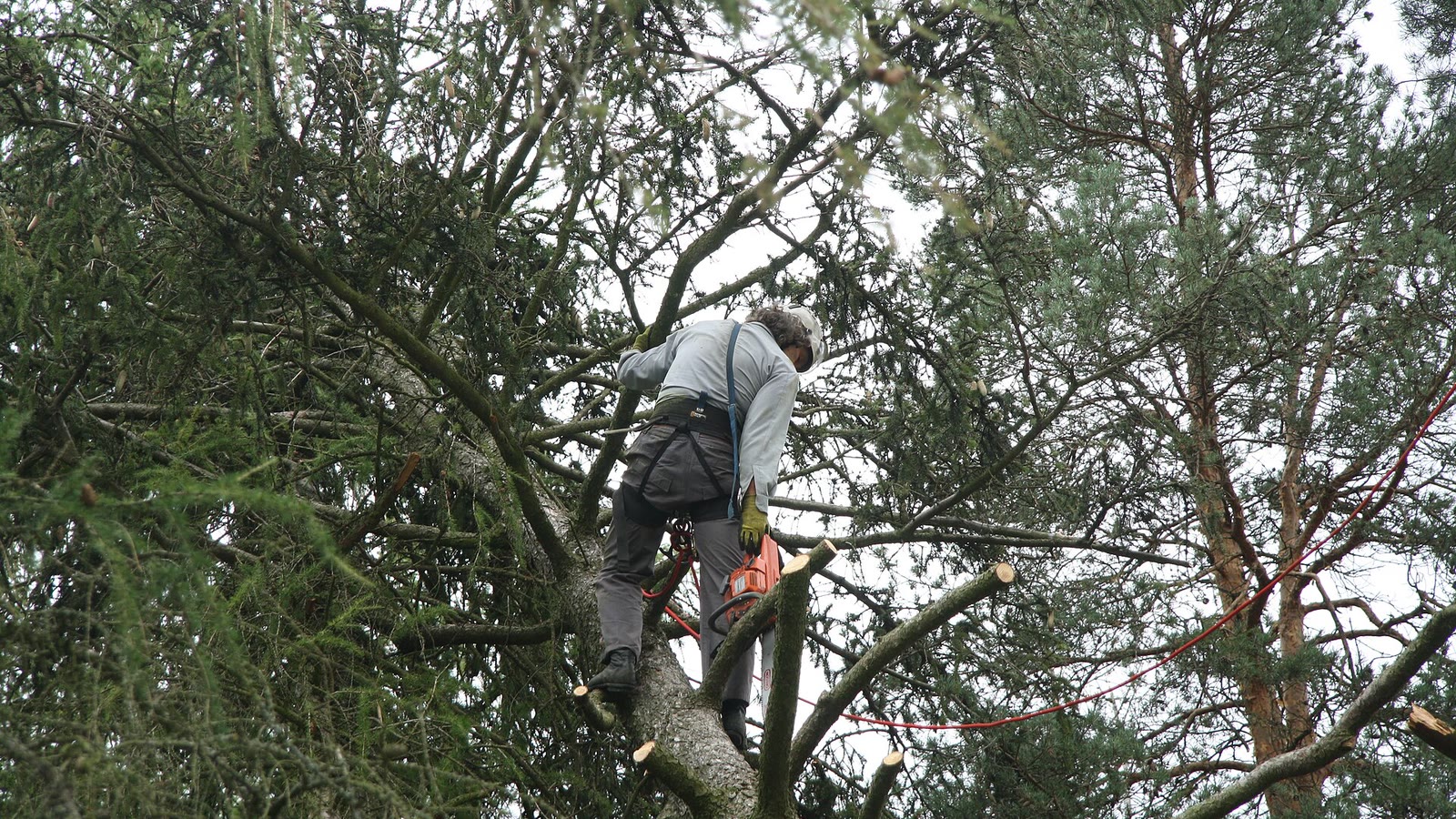
In a garden, felling a tree is allowed in principle. A prior declaration to the town hall becomes compulsory if the tree is in a classified woodland area or listed by the local development plan (PLU), if it stands within 500 m of a historic monument or in a remarkable heritage site. Since 1 October 2026, removing a hedge requires a single online declaration, except for a hedge that surrounds the garden of a house or grows inside it.
A tree in the garden: allowed, unless it is protected
As service-public.fr points out, you can fell a tree in your own garden without asking anyone. The rule no longer applies once the tree is protected. A prior declaration to the town hall is compulsory if it stands in a classified woodland area in the PLU, in a landscape feature listed by the PLU, within 500 m of a historic monument, in a remarkable heritage site or a sensitive natural area, or if the municipal council has made felling subject to authorisation. A protected species or an avenue of trees along a road also requires a procedure.
In a classified woodland area, the declaration applies even to an isolated tree; only dangerous, fallen or dead trees are exempt. In a listed site, the work must be declared four months in advance and the Architecte des Bâtiments de France (heritage architect) gives an opinion. A planning prior declaration counts as this notice.
Hedges: the single declaration since 1 October 2026
Decree No. 2026-829 of 28 August 2026 created a single regime for removing a hedge, applied to declarations submitted since 1 October 2026. The law defines a hedge as a continuous strip of vegetation no more than 20 m wide, with at least two of these three elements: shrubs, trees, other woody plants. The declaration is made online on haie.beta.gouv.fr; if the prefect does not reply within two months, it is accepted.
For most extensions, the question does not arise: hedges that form the boundary of a garden adjoining a house, or that grow inside it, are excluded from the regime, as are those along the edge of a building. A hedge between two fields, at the far end of a large unenclosed plot, is covered, however. And the PLU can protect a garden hedge in its own right.
When the hedge falls under the regime, you must replant at least the same length, multiplied by a coefficient set by the prefect (1 until one has been set). From 1 January 2027, each prefect will also set a period of at least 21 weeks without work, for nesting.
What the judge looked at in Tosse
On 3 November 2026, the urgent applications judge of the administrative court of Pau suspended the development permit for an eight-plot housing estate in Tosse, in the Landes, at the request of two local residents (as reported in the local press on 16 November). Among the grounds: 30 of the 38 trees felled when the intermunicipal PLU required them to be replaced, and no express approval from the Architecte des Bâtiments de France for the demolition, in a listed site. The ruling on the merits is still to come.
For an extension, the lesson is the same: the PLU regulations often require trees to be kept or replaced, and the planning department reads the site plan.
The trap: cut first, apply later. A protected tree felled before the town hall's approval remains an offence, and the PLU rule requiring it to be kept or replaced still applies to the extension application.
How to find out whether your tree is protected
Everything can be checked before designing the extension, in this order:
- Consult the Géoportail de l'urbanisme (national planning portal): zoning, classified woodland areas, landscape features and easements on the plot.
- Read the regulations for the zone: plantings to be kept, trees to be replaced, share of green space.
- Request an information planning certificate from the town hall if in doubt: it lists the rules and easements affecting the land.
- Submit the prior declaration for the felling, or include it in the extension application, and wait for the reply.
- Choose the season: the French Biodiversity Office advises avoiding pruning and felling from March to the end of August, and a municipality can prohibit them by local order.
Applications are now submitted online: our guide to submitting planning applications online explains the steps. On land that is still wooded, as is often the case in the Landes and Gironde, clearing requires authorisation above a threshold set by the prefect (0.5 to 4 ha depending on the department). An enclosed garden adjoining the main residence, of less than 10 ha, is exempt.
The calculation for an extension in the Landes
Worked example: two pines in the footprint of a 30 m² extension
Take, as an example, a house near Mont-de-Marsan. Two 15 m pines stand in the footprint of the future room; an oak grows 6 m from the façade. No classified woodland area, but the PLU requires felled trees to be replaced. The prices are taken for the example from published ranges: €100 to €1,500 per tree, €150 to €500 per stump with a stump grinder.
| Felling of 2 pines by a tree surgeon (€700 each) | €1,400 |
| Grinding of the 2 stumps (€300 each) | €600 |
| 2 replacement trees planted (€200 each, taken for the example) | €400 |
| Prior declaration | €0 |
| Felling done by the rules | around €2,400 |
By comparison, the fine provided for by the planning code starts at €1,200 and can reach €300,000, not counting a refused or challenged permit.
Building with the tree rather than against it
A fine oak gives shade in summer. Moving the extension a few metres or building upwards often costs less than a dispute; our article raising the roof or extending compares the two. On clay soil, a nearby tree dries out the ground and puts stress on the foundations: the geotechnical survey before building takes this into account. When replanting, respect the distances in the Civil Code: 2 m from the boundary for a tree more than 2 m tall, 50 cm below that, unless local rules say otherwise.
How we support you
In Gironde, the Landes, the Basque Country and Charente-Maritime, we read the PLU for your plot before designing an extension or a terrace, and we position the project around the trees to be kept. For a project near you, discover our full home renovation service.
Sources : Service-public.fr, abattage d’un arbre dans une propriété privée (vérifié le 17 juillet 2026) : cas où une déclaration préalable est obligatoire · Banque des Territoires, « Destruction des haies : le décret relatif au régime unique est paru » (2 septembre 2026) : décret n° 2026-829 du 28 août 2026, déclarations déposées à partir du 1er octobre 2026 · Landot & associés, « Le régime unique de la haie » (2 septembre 2026) : définition de l’article L. 412-21 du code de l’environnement, haies de jardins attenants à une habitation exclues, silence de deux mois, replantation · Selectra, « Haie arrachée : déclaration obligatoire depuis le 1er octobre » (12 octobre 2026) : haie.beta.gouv.fr, période sans travaux fixée par le préfet à partir de 2027, PLU pouvant protéger une haie de jardin · La Semaine des Pyrénées, « Landes : à Tosse, le tribunal suspend le projet de lotissement de huit lots » (16 novembre 2026) : ordonnance du tribunal administratif de Pau du 3 novembre 2026 · DREAL Grand Est, procédures en site inscrit (septembre 2024) : déclaration quatre mois avant les travaux, avis de l’architecte des Bâtiments de France · Code de l’urbanisme, article L. 480-4 : amende de 1 200 € au minimum, jusqu’à 300 000 € · Préfecture de l’Ariège, défrichement : exemptions, dont les parcs et jardins clos attenants à l’habitation principale de moins de 10 ha · Préfecture des Landes, lignes directrices du défrichement : seuil fixé par arrêté préfectoral · Office français de la biodiversité, communiqué du 24 mars 2023 : éviter la taille des haies et l’élagage de mars à fin août · FFB, le Géoportail de l’urbanisme, outil pour connaître les règles applicables à une parcelle · Service-public.fr, certificat d’urbanisme d’information · Service-public.fr, distances de plantation entre voisins (vérifié le 12 décembre 2025) : 2 m pour un arbre de plus de 2 m, 50 cm en dessous · ABC Travaux, prix d’un abattage d’arbre en 2026 (site privé) : 100 à 1 500 € par arbre · Obat, prix du dessouchage (site privé) : 150 à 500 € à la rogneuse pour une souche d’environ 50 cm
Frequently asked questions
Am I allowed to fell a tree in my garden?
Yes in principle, with no formalities. A prior declaration is needed if the tree is in a classified woodland area or listed in the PLU, within 500 m of a historic monument, in a remarkable heritage site, or if the municipality has decided so.
Do you need authorisation to remove a hedge since 1 October 2026?
A single declaration on haie.beta.gouv.fr, except for a hedge that encloses the garden of a house or grows inside it. The PLU can nevertheless protect a garden hedge.
How do you find out whether a tree is protected by the PLU?
The Géoportail de l'urbanisme shows the classified woodland areas and landscape features of each plot. If in doubt, request an information planning certificate from the town hall.
What are the risks of felling a protected tree?
A fine of at least €1,200 under the planning code, and a weakened building project. In Tosse, 30 of 38 trees felled were among the grounds for suspending a housing estate.