Advice · Grants and energy
Improving your energy rating by two classes: where to start
8 October 2026 · 5 min read · By the Aldeak team
The energy performance certificate affects comfort, bills, letting and resale. Improving the rating by two classes is often possible, provided the work is carried out in the right order.
Understanding the energy performance certificate classes
The certificate rates the house according to two criteria: its primary energy consumption and its greenhouse gas emissions, per square metre per year. The weaker of the two results determines the class. The thresholds are as follows:
- A: up to 70 kWh and 6 kg of CO2;
- B: up to 110 kWh and 11 kg;
- C: up to 180 kWh and 30 kg;
- D: up to 250 kWh and 50 kg;
- E: up to 330 kWh and 70 kg;
- F: up to 420 kWh and 100 kg;
- G: above that.
Since 1 January 2026, the calculation treats electricity more favourably (a coefficient of 1.9 instead of 2.3), which reduces the displayed consumption of electrically heated houses by around 17%. The thresholds themselves have not changed.
Why two classes make a big difference
The energy performance certificate now determines whether a home can be let:
The home can no longer be let.
Homes rated F will follow.
Then homes rated E.
When selling, an energy audit has been compulsory for houses rated F and G since 2023, and for houses rated E since 1 January 2025. Finally, improving the rating by at least two classes is the condition for obtaining MaPrimeRénov' for a whole-house renovation.
Starting from an audit
An energy audit identifies where the house loses heat and proposes costed work scenarios, with the number of classes each one gains. It is compulsory to sell a house rated E, F or G, and required for a grant-funded whole-house renovation. It is the best basis for avoiding unnecessary work.
According to Ademe, the French environment and energy agency, in an old uninsulated house heat escapes first through:
Next come the windows (10 to 15%), the ground floors (7 to 10%) and thermal bridges (5 to 10%). The order of work that follows stems from this.
1. The roof and the loft
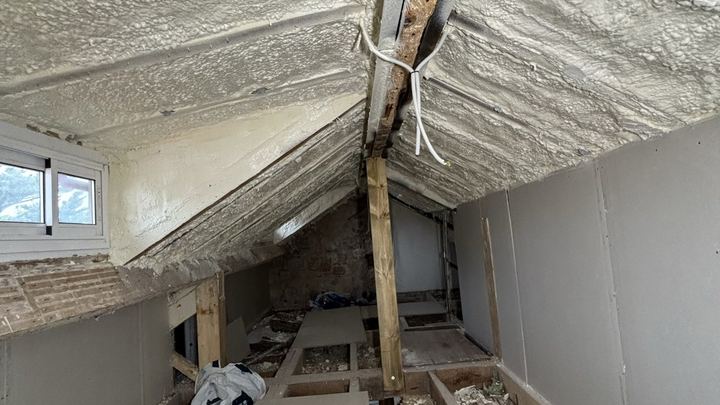
Heat rises: a poorly insulated roof is often the main source of heat loss. Insulating an unconverted or converted loft is generally the most cost-effective measure.
2. The walls
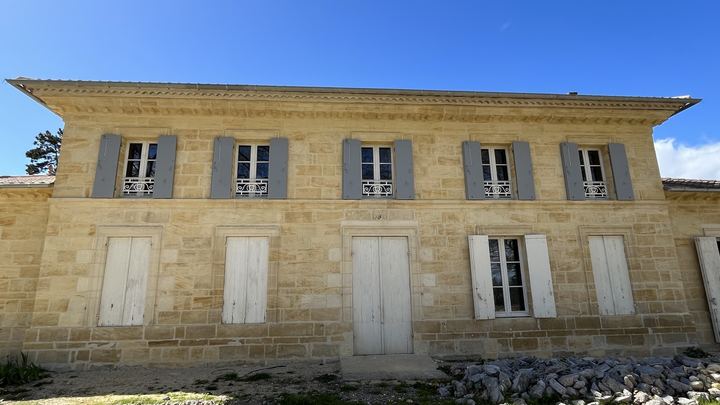
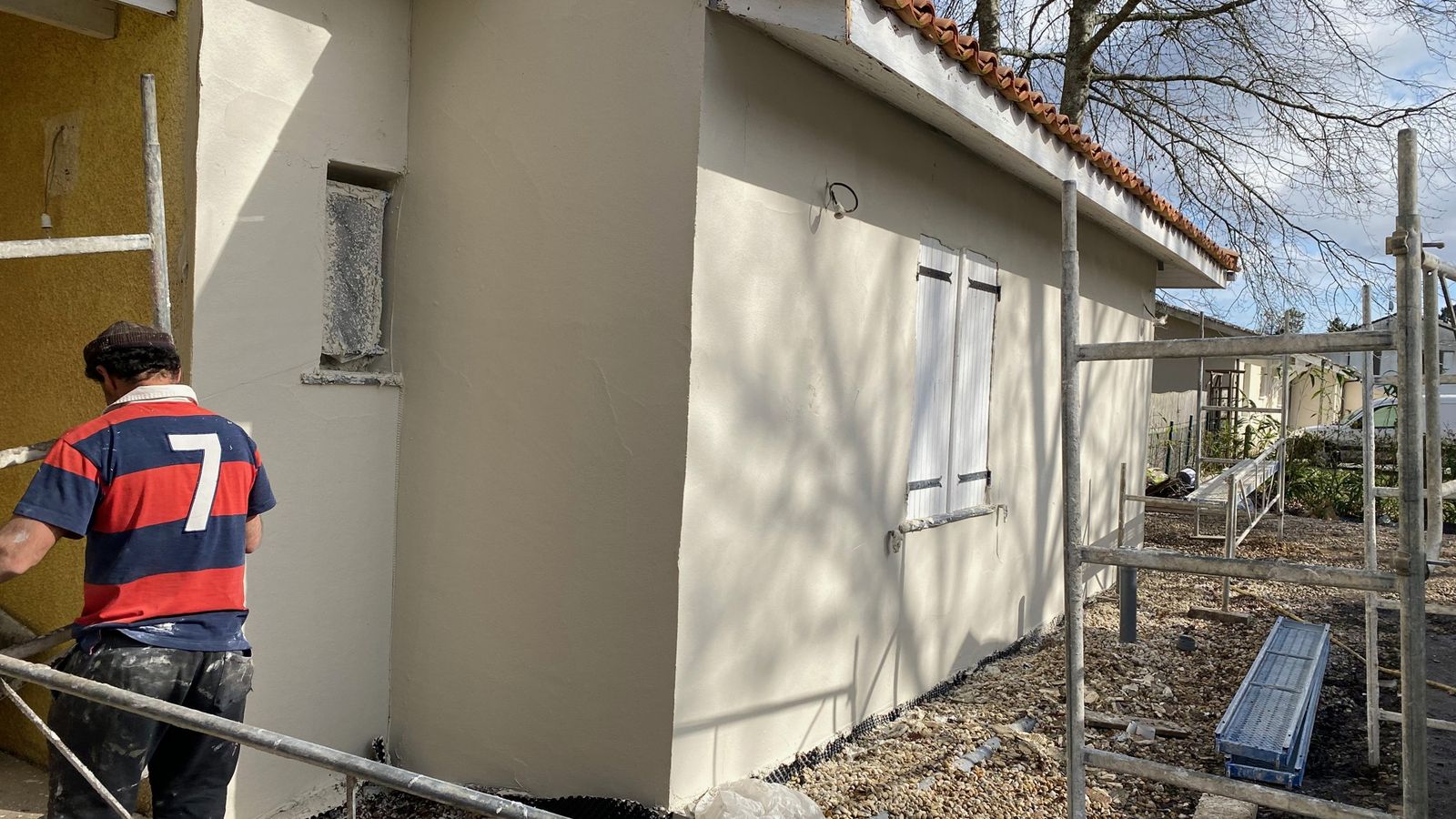
Whether from the inside or the outside, wall insulation greatly reduces heat loss. External wall insulation deals with thermal bridges and preserves the living space, but it alters the façade and requires a prior declaration. On a stone house, insulation materials that allow the wall to breathe are chosen.
3. Windows, doors and floors
High-performance, airtight windows limit heat loss and draughts. Insulating the ground floor, above a crawl space or a cellar, also noticeably improves comfort.
4. Ventilation
A better-insulated, more airtight house must be well ventilated, otherwise damp sets in. Suitable mechanical ventilation is an integral part of an energy renovation.
5. Heating and hot water
Once the needs have been reduced, a heating system sized for the renovated house is chosen: heat pump, high-efficiency boiler or wood-burning stove, depending on the case. Doing this before the insulation often leads to an oversized appliance.
Heating also weighs on the rating through greenhouse gas emissions. A house heated with oil can be rated F because of its emissions, even after insulation. Replacing oil with a lower-emission energy source is often part of the programme to gain two classes; it is in fact compulsory, in a detached house, to obtain MaPrimeRénov' for a whole-house renovation.
Worked example: a 1960s house rated F
Take, as an example, a 110 m² house heated with oil. To reach class D, emissions must also be brought below 50 kg of CO2 per square metre.
| Consumption shown on the certificate | 380 kWh/m²/year: F |
| Class D threshold | 250 kWh/m²/year |
| Reduction required | more than a third |
With an uninsulated loft and walls, old windows and an oil-fired boiler, the typical programme includes insulating the roof and walls, suitable ventilation and replacing the heating system. It is the audit that quantifies the gain from each scenario and confirms that the target is reached.
Mistakes to avoid
- Starting with the windows alone: they account for only a limited share of heat loss, and are almost never enough to gain two classes.
- Changing the heating before insulating: the appliance will be too powerful for the renovated house.
- Insulating without ventilating: damp sets in, with condensation and mould.
- Using a vapour-tight insulation material on an old stone wall: moisture remains trapped in the wall.
- Carrying out the work piecemeal without an overall plan: each measure can hinder the next, for example windows fitted before external wall insulation.
A coherent programme rather than a list of measures
Gaining two classes rarely comes down to a single measure. We coordinate all the work in the right order, with a single point of contact, in line with the audit and the available grants.
Sources : Arrêté du 31 mars 2021 relatif au diagnostic de performance énergétique (seuils des classes A à G) · Arrêté publié au Journal officiel du 26 août 2025 (coefficient de conversion de l’électricité du DPE, applicable au 1er janvier 2026) · Code de la construction et de l’habitation, article L. 126-28-1 (audit énergétique à la vente) · Loi n° 2021-1104 du 22 août 2021 « Climat et résilience » (calendrier des logements indécents E, F et G) · Ademe, guide « Isoler sa maison » (répartition des pertes de chaleur d’une maison non isolée) · france-renov.gouv.fr
Frequently asked questions
What is the most effective measure to improve an energy performance certificate?
Often insulating the roof or the loft, then the walls. The energy audit confirms this house by house.
Should the heating be changed first?
No: the needs are first reduced through insulation, then the heating is sized for the renovated house.
Is the energy audit compulsory?
It is to sell a house rated E, F or G, and for a whole-house renovation funded by MaPrimeRénov'.
Can the new 2026 energy performance certificate calculation gain a house a class?
For electrically heated houses, sometimes: since 1 January 2026, electricity has been counted with a coefficient of 1.9 instead of 2.3, which reduces the displayed consumption by around 17%. For other energy sources, nothing changes: only work improves the rating.
When will a house rated F no longer be able to be let?
From 1 January 2028, it will no longer be considered decent housing. Homes rated G have been affected since 1 January 2025, and those rated E will be in 2034.