Advice · Renovation
How much does a full renovation cost: the real items of expenditure
8 October 2026 · 5 min read · By the Aldeak team
“How much will it cost?” is the first question in any project. For a full renovation, the answer depends above all on the condition of the house and the choice of finishes. Here is how a budget is built up, item by item.
The main items in a full renovation
- Demolition and structural work: stripping out, new openings, structural repairs, masonry.
- Building envelope: roof, insulation, external doors and windows, façades.
- Services: electrics brought up to standard, plumbing, heating, ventilation.
- Fitting out: partitions, wall linings, ceilings, staircases.
- Finishes: floors, paintwork, kitchen, bathrooms, internal joinery.
- Studies and formalities: surveys, plans, structural study, permissions, diagnostic reports.
What really makes the budget vary
Two houses of the same size can have very different budgets. What weighs most: the condition of the structure and the roof, the presence of damp, electrics and plumbing that need to be redone entirely, the level of insulation targeted and, of course, the level of finish chosen.
The unknowns of older properties
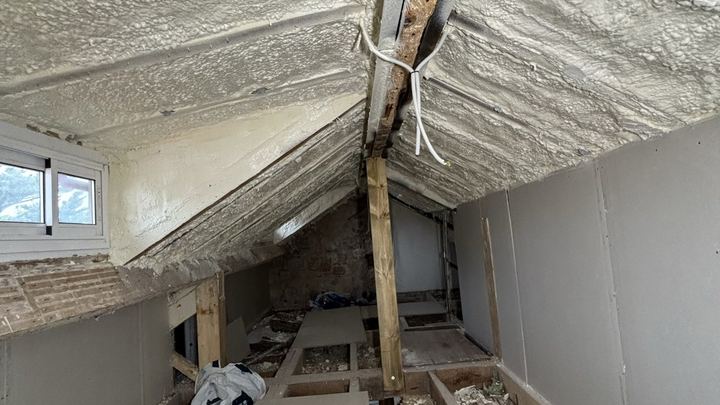
A damaged beam under a floor, a wall less sound than expected, services to be redone: in an older house, some discoveries only come to light during demolition. Setting aside a contingency reserve avoids having to halt the works or sacrifice the finishes.
Certain diagnostic reports reduce these surprises. Before works in a building whose planning permission predates 1st July 1997, a pre-works asbestos survey is compulsory: its findings may change the demolition method, and therefore the price. Targeted investigations (floors, bases of walls, roof structure) also clarify the actual condition of the structure before signing.
The items people forget
- Studies: survey, structural study, energy audit, project management.
- Diagnostic reports: asbestos, and lead in homes built before 1949.
- Taxes: the development tax (taxe d'aménagement) where floor area is created.
- Building defects insurance (assurance dommages-ouvrage), compulsory for the client who commissions works covered by the ten-year guarantee.
- Living arrangements during the works: temporary accommodation, and furniture storage if the house has to be vacated.
VAT, an item in its own right
In a home completed more than two years ago, three rates apply:
Works that increase the floor area by more than 10%, or that amount to rebuilding the house (redoing most of the foundations, walls or floors), remain at 20%. On an overall quotation, VAT is therefore allocated line by line: this is one of the reasons to ask for a detailed quotation.
The grants that reduce the bill
Part of the energy works may be financed by MaPrimeRénov', energy saving premiums or the interest-free eco-loan (éco-prêt à taux zéro), depending on your circumstances. They must be factored in from the outset, as they impose a timetable and conditions.
The interest-free eco-loan can reach €50,000 for a full renovation or when combined with MaPrimeRénov' rénovation d'ampleur (major renovation); it is available until 31 December 2027.
Grant applications must be submitted before signing the quotations. The works must also be carried out by RGE-certified contractors.
A worked example
Take, by way of example, a modest-income household renovating a house rated F, with a programme that raises it by two classes according to the energy audit.
Worked example: MaPrimeRénov' for a modest-income household
In 2026, MaPrimeRénov' rénovation d'ampleur covers 60% of the works for this household, up to a ceiling of €30,000 excluding VAT of works for a gain of two classes.
| Energy-related part of the project | €45,000 excl. VAT |
| Works ceiling for two classes | €30,000 excl. VAT |
| Rate for a modest-income household | 60% |
| Maximum grant | €18,000 |
The grant is calculated on €30,000 only; the remainder, and the whole of the decoration or fitting-out work, still has to be financed, for example with an interest-free eco-loan.
The amounts depend on income ceilings and on approval by the Anah (the French national housing agency): a simulation on France Rénov' and the advice of an Accompagnateur Rénov' adviser are essential.
Mistakes to avoid
- Comparing quotations that do not describe the same works: the cheapest is often the one that leaves out an item.
- Signing before submitting the grant applications: the grant may be lost.
- Spending the whole budget on finishes and putting off the roof or the electrics.
- Starting without a contingency reserve in an older house.
Making choices when the budget is exceeded
The first costing sometimes exceeds the planned budget. Rather than trimming everywhere, the items are sorted into three groups.
Structure, roof, concealed services, wall insulation.
A simpler fitted kitchen, temporary flooring, the loft conversion.
This can be adjusted freely.
This method protects the house and keeps open the option of finishing later, without opening up the walls again.
How to obtain a reliable budget
A sound costing is made after a visit, a survey and, if necessary, investigations. A detailed quotation, item by item, makes it possible to compare, make choices and track spending. Our online estimation tool gives an initial order of magnitude; the visit then refines the budget, for a full home renovation as well as for more targeted works.
Sources : Anah et France Rénov’, « MaPrimeRénov’, le mode d’emploi », septembre 2026 (taux, plafonds de travaux et plafonds de ressources au 1er janvier 2026) · Code général des impôts, article 244 quater U (éco-prêt à taux zéro, ouvert jusqu’au 31 décembre 2027) · Code général des impôts, articles 278-0 bis A (TVA à 5,5 % pour la rénovation énergétique) et 279-0 bis (TVA à 10 % pour l’amélioration des logements de plus de deux ans) · Code du travail, article R. 4412-97 (repérage de l’amiante avant travaux) · Code des assurances, article L. 242-1 (assurance dommages-ouvrage) · france-renov.gouv.fr · anah.gouv.fr
Frequently asked questions
Can a renovation be estimated per square metre?
Only as an initial order of magnitude: the condition of the house and the level of finish matter more than its floor area.
What contingency reserve should be set aside?
In an older property, setting aside a share of the works budget is prudent; the amount depends on the condition revealed by the investigations.
Can grants finance a full renovation?
Part of the energy works can be, depending on your income and the gain in performance, provided the rules and timetable of the grants are respected.
What VAT rate applies to a renovation?
In a home more than two years old: 5.5% for energy renovation works, 10% for other improvement works, and 20% for extensions of more than 10% of the floor area and works treated as new construction.
Can MaPrimeRénov' be combined with the interest-free eco-loan?
Yes: the interest-free eco-loan can finance the remaining cost, up to €50,000 for a major renovation, until 31 December 2027.